


Reviews
0
/ 0 отзывов
 Natural Heritage Monuments

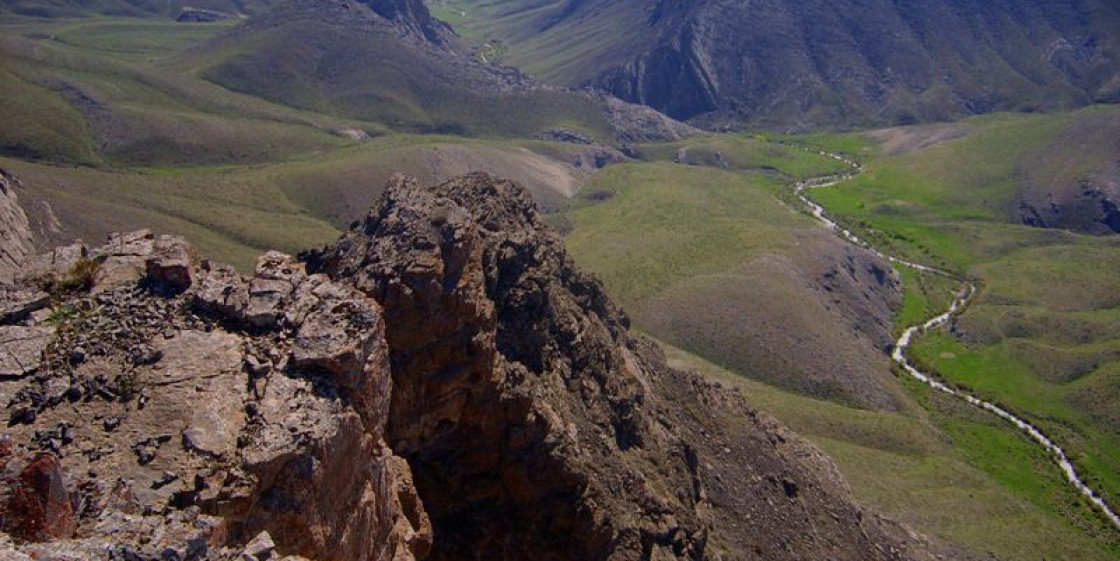
The Karatau mountain range, situated north of the middle course of the Syrdaria river, is a tectonic uplift to 1500 m. that happened 1.5-1 million years ago. It shows today, on its top, fragments of former plains, on the slopes, evident layers of the phases of formation; on its feet fossil terraces and the world-wide unique phenomenon of griffons, resurgences of underground waters sedimenting carbonates.
For these reasons, the area is an important polygon of geological studies. Besides its geological importance, the Karatau mountains assume an ever greater paleonthological importance for the presence of exclusive and extremely well preserved fossils belonging to the early pleistocenic fauna (Koskurganskaya fauna: equus mostbahensis, elasmarii sibiricum, strutio species, etc.), and for its Paleolithic sites where stone tools assemblages have been found that represent the all process of development of stone-ages cultures from the early stages of the Early Paleolithic (1 million BP) to the Neolithic period (6500 BP).
So, the area represents a complex system showing how a mountain range itself, its fauna and its early human inhabitants rose and developed synchronically for one million years, with a variety and a mutual integration of geological, zoological and Paleolithic remains not found elsewhere. Up to the present around 300 Paleolithic sites have been found, and only 20% of them excavated. They are scattered all over the range, on its northern and southern slopes, and at different altitudes.
The Early Paleolithic sites are situated in the mountains (1300-1100 m), where stone tools can be found, in grey silex (Aristandi culture, 1.000.000-500.000 BP), and in black silex (Bory--Kasgan and Tom-Kasgan cultures, 500.000-100.000 BP). The Middle Paleolithic sites are mostly situated in the griffons of the foot hills (500 m), where stone tools of Moustarian culture can be found, as well in silex, as well in sandstone, showing the immigration in the area of new populations from northern regions.
The griffons constitute an exceptional source of findings, in spite of the fact that only 5 out of 40 that exist have been excavated. The Late Paleolithic sites (Valikanov-Karasu settled cultures, 30-15000 BP) are situated on the terraces (800-500 m), and so the Mesolithic ones, represented by a big number of settlements. A hiatus (9000- 6500 BP) shows that a worsening of climate depopulated the area; and Neolithic cultures developed again around the wells of the area only around 6500 BP.
The Paleolithic complex of Karatau is of outstanding universal value for the reconstruction of the genesis and evolution of Paleolithic Eurasian cultures together with their geological and climatic environment. It supports the theory of Central Asia as a primordial homeland of the modern man (per-Asiatic type); testifies an interchange of local and northern cultures during the last interglacial, and, when correlated with paleoclimatic reconstructions, the extreme sensibility of Paleolithic communities to climatic changes.
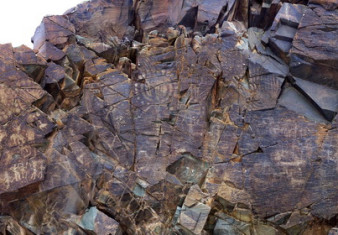
Set around the lush Tamgaly Gorge, amidst the vast, arid Chu-Ili mountains, is a remarkable concentration of some 5,000 petroglyphs (rock carvings) dating from the second half of the second millennium BC to the beginning of the 20th century.
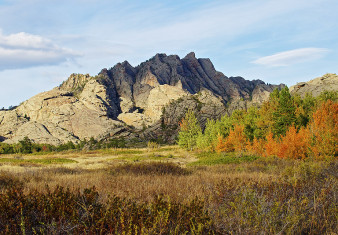
Saryarka - Steppe and Lakes of Northern Kazakhstan comprises two protected areas: Naurzum State Nature Reserve and Korgalzhyn State Nature Reserve totalling 450,344 ha.
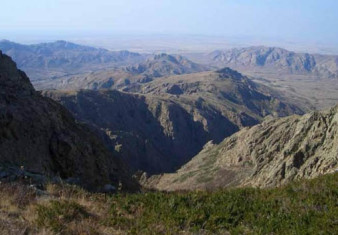
The cultural landscape of Ulytau is situated in the semi-desertic zone of Central Kazakhstan and it shows all its typical natural features: low mountains, conical-shaped hills, plains, river valleys and lakes.
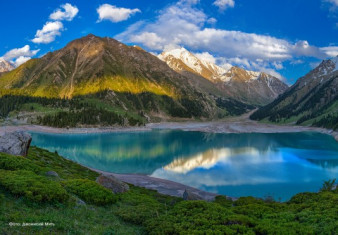
The natural object of nomination is located on the northern macrohillside of the ridge Trans-Ili Ala-Tau, which is the part of Northern Tyan Shan physical geographic province (Gvozdetskiy, Nikolaev, 1971).
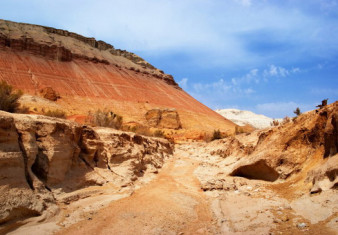
Altyn-Emel State National Nature Park is sprawled in the heart of Central Asia, in the valley of the Ili River, about 150 kilometers away from Almaty, Kazakhstan’s largest city.
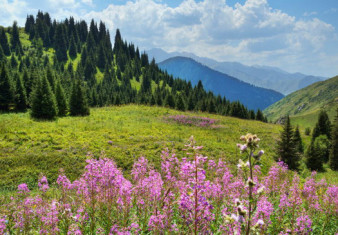
The Aksu-Zhabagly Nature Reserve is the oldest nature reserve in Central Asia. It is located in the southern province of the Republic of Kazakhstan.


