


Reviews
0
/ 0 отзывов
 Cultural heritage

Saumalkol, the main settlement in the area, is 22km northwest of Ayirtau. From Saumalkol head southwest on the road towards Ruzaevka, turning left after 3km onto a road signposted to the Karasai and Agyntai Batyr Memorial Complex. Turn right, again signposted to the complex, after a further 13km. The monument itself, two cones on the crest of a low hill, is visible from afar and guides you the final 11km towards it.
The Karasai and Agyntai Batyr Memorial Complex, opened in 1999, honours the two Kazakh warriors of the 17th century who fought together against the Dzhungars for several decades. The focus on these figures in post-independence Kazakhstan, including this lavish memorial complex and a monument in Petropavl is based around the idea of Kazakhs of different tribes working together in pursuit of a greater common goal.
Karasai Batyr was born in present-day Almaty Region, from the Shaprashty tribe of the Great Zhuz. President Nazarbaev belongs to the same tribe, which is perhaps a further factor underpinning Karasai Batyr's current popularity. Agyntai Batyr was from the north of the country, a member of the Argyn tribe of the Middle Zhuz.
Their many joint exploits in battles against the Dzhungars included involvement in the Kazakh victory at the Battle of Orbulak in 1643, and helping to free the Kazakh khan, Salqam Zhangir, from captivity. Karasai Batyr died in 1671, at the age of 73, and was reportedly buried here in the Kulshinbay Hills of North Kazakhstan. Agyntai Batyr died a year later, and was buried next to his friend.
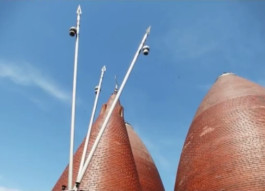
The form of the monument is striking: two cones of brown brick, 16m in height, vaguely resembling oasthouses or giant termite mounds, stand side by side. In front of them is a slightly smaller building, also circular-based and with a roof shaped like an upside-down ice-cream cone.
This is a mosque, its position between the two mausolea symbolically uniting them in prayer. Three tall metal spears fan out in front of each of the two mausolea. Within the mausolea, the two graves - that of Agyntai in the building on the left, Karasai on the right - are marked by a kulpytas and koytas, engraved with images of their weaponry and the symbols of their tribes.
Piles of rocks around the back of the monument symbolise the graves of family members of the batyrs. A plaque records that the memorial complex was built under the initiative of President Nazarbaev. The caretaker tends to leave around 18.00, locking up the complex for the night.
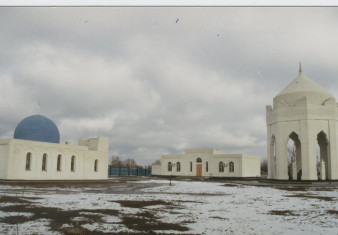
In 50 km from the modern city of Atyrau, there is one of perspective tourist routes, regional memorial estate "Khan Ordaly Sarajshyk" who opens all ancient history of the Kazakh people.
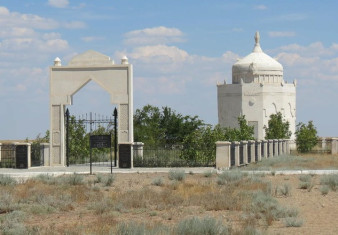


The grave site of the great Kazakh poet of the 19th century, free-thinker and inspirer of the rebellion of Makhambet Utemisov is situated in Inder, Atyrau region, 40 km to the south-east from the village Inderbor.
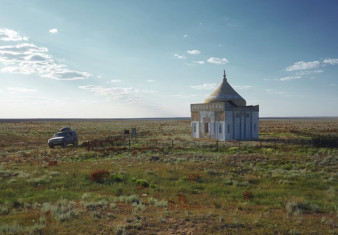
Atyrau region is rich in its architectural monuments of culture, one of them is considered to be Zhuban Mausoleum.
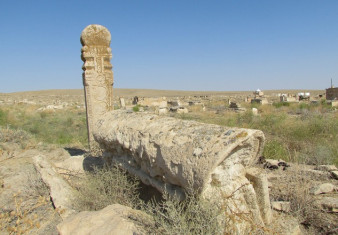
Senek reserve is an architectural monument of the XVII - XX centuries, it represents a necropolis consisting of several sepulchral constructions and an old mosque.
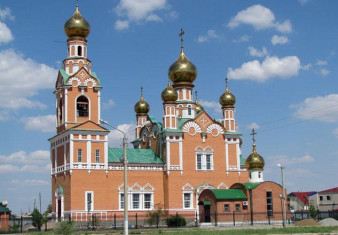
One of the oldest and most beautiful architectural monuments of the city - Uspenski Cathedral is located in the heart of the city of Atyrau, on Issatay Taimanov street, just a few steps from the main square.
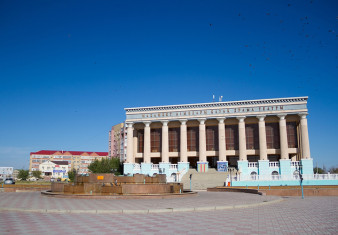
One of the leading places in the cultural life of Atyrau and the whole Atyrau region belongs to the Kazakh Drama Theater named after Makhambet Utemisov.


