


Reviews
0
/ 0 отзывов

 Cultural heritage

The ancient settlement Koylyk (Antonovka) is located on river banks Ashchi-Bulak in 190 km to the northeast of the city of Taldykorgan, in the eastern suburb of the modern, village of Koylyk of the same name in Almaty region.
From reliable written sources of XI - the beginning of the 13th centuries it is known that it was the capital the Karluk's dzhabgu, independent possession of Turkic and Karluk people in a Karakhanid Khaganate.
Europeans thanks to the book by the French monk Guillaume Rubruk – "A travel to East countries" written in 50 years of the 13th century also knew about this city.
Archaeological researchers of the ancient settlement have begun in 1964 when under the leadership of K.M. Baypakov, then a number of holes have been put here and is made a plan ancient settlements after that scientific works weren't carried out here for many years.
They have been renewed only in 1998 within the Southern Kazakhstan Complex Archaeological Expedition during which the object identified as "the Buddhist temple" has been dug out, and the inhabited estate on an ancient settlement citadel is also explored.
In 1999-2000 works on the so-called "estate of the rich person" localized in a southeast part of the ancient settlement were carried out.
In 2001 the bath like "hammam" put from a burned brick is opened, and the mausoleum built to territories of the ancient settlement in the period of desolation is also explored. In 2002-2003 works have been concentrated on studying of a stratigraphy, creation of a digital three-dimensional topographical basis of a monument and also the conservation actions and monitoring which are carried out on "the Buddhist temple".
Field seasons of 2004 and 2005 are marked by the opening of the Friday mosque of column type, the "Manichean" temple, mausoleums which facades have been decorated with a magnificently carved terracotta, located near mausoleums.
The complex of construction, a public character, have given unique material during the researches of 2006-2007. Open monuments allow beginning powerful archeologic and memorialized researches.
The conducted researches have allowed describing an ancient monument as the city with three-part structure characteristic of the majority of medieval monuments of Kazakhstan.
The ancient settlement in the plan has the form of the wrong quadrangle focused by corners on parts of the world, surrounded by walls. The northeast wall has extent about 1200 m, southwest 750 m, and the southwest party the ancient settlement closely adjoins mountains.
Approximately through each 30-45 m on a wall towers roundish in respect of a form are arranged. Near the western corner, the hillock, subsquare in respect of a form, the sizes of 70х80 m and 4,5 m high is located.
Entrances have been arranged in the northwest, northeast and southeast parties. Inside all extensive territory of the ancient settlement is covered with numerous hillocks, hollows – traces of former building.
The cob walls put by the method of tape filling, which has become swollen on the width of 11-13 m with the remained height up to 2-2,5 m, border squared building of a Shakhristan (City Centre) and, most likely, a part of Rabat, with a total area of 90 hectares.
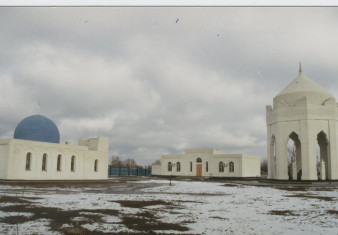
In 50 km from the modern city of Atyrau, there is one of perspective tourist routes, regional memorial estate "Khan Ordaly Sarajshyk" who opens all ancient history of the Kazakh people.
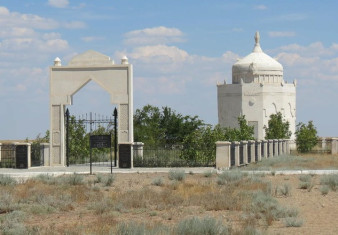


The grave site of the great Kazakh poet of the 19th century, free-thinker and inspirer of the rebellion of Makhambet Utemisov is situated in Inder, Atyrau region, 40 km to the south-east from the village Inderbor.
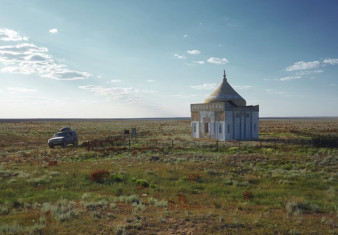
Atyrau region is rich in its architectural monuments of culture, one of them is considered to be Zhuban Mausoleum.
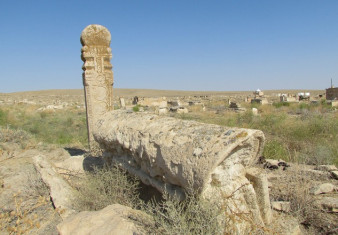
Senek reserve is an architectural monument of the XVII - XX centuries, it represents a necropolis consisting of several sepulchral constructions and an old mosque.
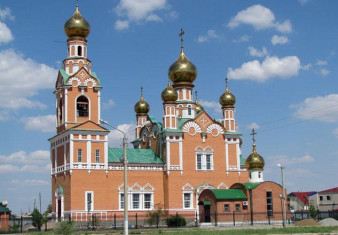
One of the oldest and most beautiful architectural monuments of the city - Uspenski Cathedral is located in the heart of the city of Atyrau, on Issatay Taimanov street, just a few steps from the main square.
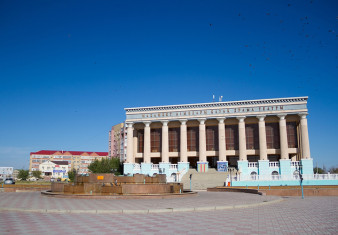
One of the leading places in the cultural life of Atyrau and the whole Atyrau region belongs to the Kazakh Drama Theater named after Makhambet Utemisov.


